My mind is powerpoint addled. Every day is a fantastically productive blur marked by unbroken chains of conference calls and conversations mostly unleavened by creativity. Most evenings I spend equally actively. Running to a showing of Pink Floyd's The Wall in the Castro theater or a farewell cum birthday cum Michael Jackson tribute party in a SoMa loft for a dear friend going away. A home showing followed by a sushi dinner. Faux-Walks for real causes in parks. Declined invites to a meteor shower viewing and weekend afternoon concerts because of prior commitments or dire exhaustion.
And amidst all this crazy-busyness somehow the growing sense that life is increasingly sluggish. Calls to Spanish tutorial schools and Writing courses never get placed. The realization of having missed gym again seems to hit only after I step out of the shower. Skipped Meditation sessions in favour of hops. Neglected blogs.
There were times when writing cleared the mind. I could try it again. Then again, an automated car wash couldn't wash away that cobweb that still clings to my Prius' side mirror.
A sign?
Tuesday, August 11, 2009


Sunday, June 14, 2009
Sometimes One Good Revolution Deserves Another
TO PERSIA WITH LOVE
 How's this for 'Change'? From Hope to Disillusionment
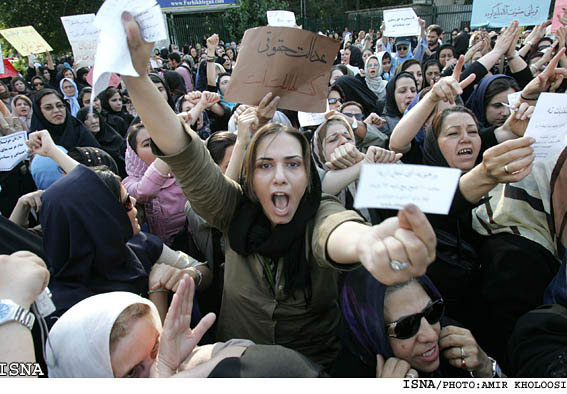
I’m not qualified to write about Iran and the political developments there. But I feel compelled to do so…because through my very limited first hand and more extensive second hand exposure, I’ve developed a deep fondness for Iran. Not the regime but the people.
My earliest exposure to Iran came in the late eighties (I think I was 12 years old) through a Reader’s Digest story about the horrors of the Islamic regime. The anecdote from that article that remains stuck in my mind till today, was about a woman who had her lips cut off for wearing lipstick. Still new to the ways of the world I remember being horrified by the brutality of the action and asking my father if this and the other things the story said were true. His reply was that this was mostly American propaganda. The truth I’m sure, as it usually is, was somewhere in the middle. Despite my dad's dismissal of the article, for years I carried a picture of Iran as a country full of closed-minded, hostile religious fundamentalists who were opposed to most modern freedoms. I didn't distinguish between the regime and the people.
But during a short 3 day business trip to Tehran a few years back, all this changed for me. I landed in Tehran after trips to the UAE (Dubai, Sharjah, Ras al Khaimah and Abu Dhabi) and Muscat and it was quite a shock to discover that in many ways Iran seemed more liberal (at the time) than the Arab societies in those cities (except perhaps for Dubai) In Muscat for example, all my business meetings were with men; where women were present they were usually Indian and usually in the role of assistants. In the main market in Muscat maybe one in ten of the people milling about were women; all were in full length, head to toe black burkhas, with a veil covering their face leaving only a slit for the eyes. In Tehran over 2-3 days in six or seven meetings I met at least 3 women executives; there was the usual ‘healthy’ mix of men and women in the streets; you saw women driving cars alone late at night (something they would not be able to do in Saudi Arabia any time of the day). I was being guided through the different meetings by a woman sales representative and the meeting dynamics between her and her male counterparts in the companies we visited were no different than they would be in India. The women all wore hijabs of course, as did my host, but they were of many colours; the head scarves were usually colourful, the faces were not veiled for the most part and yes – many women wore lipstick. This is not to say that the country wasn’t a conservative Islamic society – it clearly was. But it wasn’t any more so (and in some ways was less so) than some of the other countries in the region that gain much less notoriety per capita oppression that they impose of their people.
The other thing that made Tehran fascinating was to witness the hundreds of small ways in which the people were choosing to rebel. Combined with the sophistication of the people I met, these signs of rebellion endeared the Iranian people to me, forever. For I’m nothing if not a romantic. The signs were everywhere you looked: the short knee-length capes that the younger women wore to reveal their fashionable jeans; the head scarves that were allowed to slip back to reveal most of the hair; the wry, self-deprecating comments that several people made to me about the government (one of them asked me what I thought about the Islamic republic of Iran, coming from India as I did, placing an emphasis on “Islamic” in a way that made it clear that he didn’t think much of it at all); Michael Jackson’s Thriller blaring out of a car racing by even though all forms of non-Islamic music are banned in the country; being offered an alcohol free malt beer by another procurement manager who said he escaped to India several times a year and was an admirer of Bhagwan Rajneesh; the young couple holding hands in an intimate corner of a trendy restaurant in broad afternoon-light. The lady who hosted me in Tehran told me that a lot of these small grabs at freedom had become increasingly common since Khatami came to power. She told me how people had satellite dishes at home, all the latest CDs and books that were officially banned. Of raucous house parties that substituted for late night bars and clubs that were conspicuous by their absence.
It was Khatami’s second term, a time when hopes of rapid social liberalization were fading. Despite that the impression you gained was of a society that assumed change would occur, if only more slowly than many people wanted. That the change could come from within the system which provided the “safety valve” of an elected president. That safety valve provided a degree of legitimacy to the regime in the eyes of the people. It also provided the strongest threat to the survival of the theocratic state as it stands today. The presidency in Iran only has limited power and can put progressive change into only the first or second gears. But slow change is still change and the Iranian regime wouldn’t be the first one to resort to naked theft to prevent pesky reformists from getting their hands on the levers of power. Mousavi is widely described as being a reformist in quotes. No one is sure that he would bring a lot of reform to the system…but he is for example, clearly comfortable with an expanded, more independent role of women, going by the role his wife played in the election campaign. That itself is probably anathema to the core beliefs of the conservative old guard. I don’t think this is about Mousavi alone though. 70% of Iran is younger than 30 and following Khatami’s two landslide victories, and the way that Mousavi’s campaign caught fire in just 4 weeks; the religious conservatives probably realized that left to themselves, Iranians would elect progressive, reformist presidents in perpetuity. The system has to be destroyed to save the system. And that’s what Khamenei and Ahmadinejad have done. They’d have probably done this in 2005 if the reformist voters hadn’t largely boycotted the polls obviating the need to do so.
I can understand their motives. The margin of victory is so incredible, the rigging so blatant, that it makes one think that they didn’t just want to cheat but also wanted to let the population know that they could and would cheat. That they are serious about not allowing reform and that anyone who really wants change will have to fight for it. Khamenei and company are betting that the people won’t put up much of a fight. Though the legitimacy of the regime has been blown to smithereens in the eyes of its people, the street protests that have happened till now won’t necessarily mean the beginning of the end of the regime. Michael Elliott has written a great article about this in Time...he mentions the 1968 Prague Spring, the 1956 Hungarian uprising and Tiananmen Square in 1989: flashpoint protests that were quelled by regimes that then continued for 20-40 more years. Burma is another example. If they succed today, over the next few years it’s quite likely that the conservatives will use power to entrench themselves further and intimidate dissidents once the initial furor has died down and the attention of the world has shifted.
On the other hand, from the vantage point of my armchair, this seems a particularly propitious time to fight for change in Iran. The betrayal is farm-fresh in people’s minds. In Mousavi and his wife and in Khatami they have dissident leaders around who the opposition can rally around; not just the reformist forces but also those conservatives who are coming out to reject an illegitimate power-grab. These leaders will probably be neutralized over time. On the other hand, the Islamic regime’s bogeyman, America, has a president who can differentiate between a regime and its people and who understands nuance and subtlety. That somewhat neutralizes the conservatives’ traditional rallying point. Right now the fight can be simply for a presidential election annulment …something that can be achieved in a face-saving way through the Guardian council’s decision. After this the reformists’ will probably have to mount a full-scale revolution which is much more difficult. Freedom comes at a cost and the Iranian people will have to pay it either today by persisting in their protests in face of the inevitable violent crackdown or over time by suffering a more violent and more conservative regime for the next several decades. I hope they choose to pay it today in the form of persistent and escalating protests across the country, even if there's intimidation. It has after all, worked once before in 1979.
My lovely host was in her mid-to-late thirties when I met her and had grown up in the most conservative decades of the Islamic regime, suffering dire restrictions on her freedom. I will always remember, her telling me with unqualified sadness, that she belonged to the "lost generation of Iran". Let's pray that her’s is the last one.
My earliest exposure to Iran came in the late eighties (I think I was 12 years old) through a Reader’s Digest story about the horrors of the Islamic regime. The anecdote from that article that remains stuck in my mind till today, was about a woman who had her lips cut off for wearing lipstick. Still new to the ways of the world I remember being horrified by the brutality of the action and asking my father if this and the other things the story said were true. His reply was that this was mostly American propaganda. The truth I’m sure, as it usually is, was somewhere in the middle. Despite my dad's dismissal of the article, for years I carried a picture of Iran as a country full of closed-minded, hostile religious fundamentalists who were opposed to most modern freedoms. I didn't distinguish between the regime and the people.
But during a short 3 day business trip to Tehran a few years back, all this changed for me. I landed in Tehran after trips to the UAE (Dubai, Sharjah, Ras al Khaimah and Abu Dhabi) and Muscat and it was quite a shock to discover that in many ways Iran seemed more liberal (at the time) than the Arab societies in those cities (except perhaps for Dubai) In Muscat for example, all my business meetings were with men; where women were present they were usually Indian and usually in the role of assistants. In the main market in Muscat maybe one in ten of the people milling about were women; all were in full length, head to toe black burkhas, with a veil covering their face leaving only a slit for the eyes. In Tehran over 2-3 days in six or seven meetings I met at least 3 women executives; there was the usual ‘healthy’ mix of men and women in the streets; you saw women driving cars alone late at night (something they would not be able to do in Saudi Arabia any time of the day). I was being guided through the different meetings by a woman sales representative and the meeting dynamics between her and her male counterparts in the companies we visited were no different than they would be in India. The women all wore hijabs of course, as did my host, but they were of many colours; the head scarves were usually colourful, the faces were not veiled for the most part and yes – many women wore lipstick. This is not to say that the country wasn’t a conservative Islamic society – it clearly was. But it wasn’t any more so (and in some ways was less so) than some of the other countries in the region that gain much less notoriety per capita oppression that they impose of their people.
The other thing that made Tehran fascinating was to witness the hundreds of small ways in which the people were choosing to rebel. Combined with the sophistication of the people I met, these signs of rebellion endeared the Iranian people to me, forever. For I’m nothing if not a romantic. The signs were everywhere you looked: the short knee-length capes that the younger women wore to reveal their fashionable jeans; the head scarves that were allowed to slip back to reveal most of the hair; the wry, self-deprecating comments that several people made to me about the government (one of them asked me what I thought about the Islamic republic of Iran, coming from India as I did, placing an emphasis on “Islamic” in a way that made it clear that he didn’t think much of it at all); Michael Jackson’s Thriller blaring out of a car racing by even though all forms of non-Islamic music are banned in the country; being offered an alcohol free malt beer by another procurement manager who said he escaped to India several times a year and was an admirer of Bhagwan Rajneesh; the young couple holding hands in an intimate corner of a trendy restaurant in broad afternoon-light. The lady who hosted me in Tehran told me that a lot of these small grabs at freedom had become increasingly common since Khatami came to power. She told me how people had satellite dishes at home, all the latest CDs and books that were officially banned. Of raucous house parties that substituted for late night bars and clubs that were conspicuous by their absence.
It was Khatami’s second term, a time when hopes of rapid social liberalization were fading. Despite that the impression you gained was of a society that assumed change would occur, if only more slowly than many people wanted. That the change could come from within the system which provided the “safety valve” of an elected president. That safety valve provided a degree of legitimacy to the regime in the eyes of the people. It also provided the strongest threat to the survival of the theocratic state as it stands today. The presidency in Iran only has limited power and can put progressive change into only the first or second gears. But slow change is still change and the Iranian regime wouldn’t be the first one to resort to naked theft to prevent pesky reformists from getting their hands on the levers of power. Mousavi is widely described as being a reformist in quotes. No one is sure that he would bring a lot of reform to the system…but he is for example, clearly comfortable with an expanded, more independent role of women, going by the role his wife played in the election campaign. That itself is probably anathema to the core beliefs of the conservative old guard. I don’t think this is about Mousavi alone though. 70% of Iran is younger than 30 and following Khatami’s two landslide victories, and the way that Mousavi’s campaign caught fire in just 4 weeks; the religious conservatives probably realized that left to themselves, Iranians would elect progressive, reformist presidents in perpetuity. The system has to be destroyed to save the system. And that’s what Khamenei and Ahmadinejad have done. They’d have probably done this in 2005 if the reformist voters hadn’t largely boycotted the polls obviating the need to do so.
I can understand their motives. The margin of victory is so incredible, the rigging so blatant, that it makes one think that they didn’t just want to cheat but also wanted to let the population know that they could and would cheat. That they are serious about not allowing reform and that anyone who really wants change will have to fight for it. Khamenei and company are betting that the people won’t put up much of a fight. Though the legitimacy of the regime has been blown to smithereens in the eyes of its people, the street protests that have happened till now won’t necessarily mean the beginning of the end of the regime. Michael Elliott has written a great article about this in Time...he mentions the 1968 Prague Spring, the 1956 Hungarian uprising and Tiananmen Square in 1989: flashpoint protests that were quelled by regimes that then continued for 20-40 more years. Burma is another example. If they succed today, over the next few years it’s quite likely that the conservatives will use power to entrench themselves further and intimidate dissidents once the initial furor has died down and the attention of the world has shifted.
On the other hand, from the vantage point of my armchair, this seems a particularly propitious time to fight for change in Iran. The betrayal is farm-fresh in people’s minds. In Mousavi and his wife and in Khatami they have dissident leaders around who the opposition can rally around; not just the reformist forces but also those conservatives who are coming out to reject an illegitimate power-grab. These leaders will probably be neutralized over time. On the other hand, the Islamic regime’s bogeyman, America, has a president who can differentiate between a regime and its people and who understands nuance and subtlety. That somewhat neutralizes the conservatives’ traditional rallying point. Right now the fight can be simply for a presidential election annulment …something that can be achieved in a face-saving way through the Guardian council’s decision. After this the reformists’ will probably have to mount a full-scale revolution which is much more difficult. Freedom comes at a cost and the Iranian people will have to pay it either today by persisting in their protests in face of the inevitable violent crackdown or over time by suffering a more violent and more conservative regime for the next several decades. I hope they choose to pay it today in the form of persistent and escalating protests across the country, even if there's intimidation. It has after all, worked once before in 1979.
My lovely host was in her mid-to-late thirties when I met her and had grown up in the most conservative decades of the Islamic regime, suffering dire restrictions on her freedom. I will always remember, her telling me with unqualified sadness, that she belonged to the "lost generation of Iran". Let's pray that her’s is the last one.
Monday, May 25, 2009
When Life is Like a Song
Or why I love San Francisco (and the surrounding area)
Three weekends back P, H, P and I decided we’d spend a Friday night chilling out at a bar rather than in the midst of a frenzied crowd at a club. We picked this bar called Van Kleef (or something like that) in Oakland. It had an attitude all its own – a long narrow corridor that ran along the bar, opened into a wider seating area at the back. The seating area was circumscribed by a high raised stage stacked with musical instruments – trumpets, guitars, even a piano. Dim, intimate lighting, high ceilings, and burgundy walls covered with somehow-Gothic but mostly themeless (to my admittedly untrained eye) paraphernalia rounded out the bar’s look. It all worked improbably well in creating a cosy, laid-back ambience even though the chairs were distinctly non-lounge-y: cushion-less, narrow and straight-backed.
It took us a while to find cocktails that the bar actually was able to make and beers that they stocked but once we did, we were able to spend a comfortable couple of hours solving the world’s problems. Having brought Kim Jong Il to his senses, we’d just started working on the vexed question of the Golan Heights when the bar began to fill up with people who looked like they’d all got the wrong address. They were decked up in ballroom fashions from the 1940s/50s. Men and some very butch looking women in tuxedos and bow ties. The women and perhaps some men in drag in lovely, brightly coloured gowns, high heels and wide-brimmed hats. We watched in fascination (and mounting embarrassment at our own t-shirt and jeans attire) as each new person glided out of the ballroom scenes in The Aviator and into the space in front the stage.
It turned out that the bar was hosting a themed birthday party for a transgender male-to-female (MTF) cabaret singer. The crowd was really diverse as perhaps only a crowd in SF or NYC or London can be. There were men, women, MTFs and FTMs. Gay men and lesbians and straight people. White people and black people. There may have been people of East Asian extraction. There were probably a couple of Hispanics sprinkled in. But if not, our table provided representation for brown-hued humanity – (unwitting) gatecrashers as is sometimes our race's wont to be. The birthday girl herself was dressed in something that made her look delicate and pretty – though I'm not quite sure what colour. My alcohol-addled mind was on sensory overload by then. You know how sometimes you miss the woods for the trees? Well I was doing the opposite. I was pretty much focused on the tableau (of glammahrous dresses) rather than the individuals wearing them. It was a little surreal.
But then of course, since we now had showbiz people in the same space as a stage stacked high with musical instruments, members of the party got up on stage one by one to sing to the birthday girl. One guy took the piano and sang a Monroesque Happy Birthday. His piano playing was way better than his singing from what I remember and happily it was not long before other members of the group divested him of the task of keeping the evening sounding mellifluous. For me the highlight of the evening came when a traditionally built black woman got in front of the microphone. She looked fabulous in a fire-engine red gown (I don’t use the word gratuitously here, this was one of those occasions where the adjective really did fit). She seemed to exude good humour and nice-ness. You just knew she was going to be a good singer. She had a bit of a Mata Amritanandmayi air to her - I had this irresistible urge to be hugged by her. Her face glowed with her inherent goodness or maybe with the reflection of the overhead light. She said she was going to sing the song that she had sung at the her friend's (the birthday girl) wedding. That’s when the husband walked over – dapper in black tie. He was also transgender – Female to Male. He held his hand out to his seated wife and she rose to meet him. And as he drew her close, the lady in red started singing. She sang what’s become one of my favourite songs since the Obama inauguration, At Last. She sang
At Last My love has come along
My lonely days are gone
And life is like a song…
I knew we'd stumbled into a magical moment. In a world that venerates love but then, often does all it can to keep its definition strait-jacketed or thwart it in favour of tradition or 'normality', these two had been improbably successful in finding themselves and then each other. And then even more improbably, a group of friends who celebrated them and their love.
Life can be beautiful sometimes.
Three weekends back P, H, P and I decided we’d spend a Friday night chilling out at a bar rather than in the midst of a frenzied crowd at a club. We picked this bar called Van Kleef (or something like that) in Oakland. It had an attitude all its own – a long narrow corridor that ran along the bar, opened into a wider seating area at the back. The seating area was circumscribed by a high raised stage stacked with musical instruments – trumpets, guitars, even a piano. Dim, intimate lighting, high ceilings, and burgundy walls covered with somehow-Gothic but mostly themeless (to my admittedly untrained eye) paraphernalia rounded out the bar’s look. It all worked improbably well in creating a cosy, laid-back ambience even though the chairs were distinctly non-lounge-y: cushion-less, narrow and straight-backed.
It took us a while to find cocktails that the bar actually was able to make and beers that they stocked but once we did, we were able to spend a comfortable couple of hours solving the world’s problems. Having brought Kim Jong Il to his senses, we’d just started working on the vexed question of the Golan Heights when the bar began to fill up with people who looked like they’d all got the wrong address. They were decked up in ballroom fashions from the 1940s/50s. Men and some very butch looking women in tuxedos and bow ties. The women and perhaps some men in drag in lovely, brightly coloured gowns, high heels and wide-brimmed hats. We watched in fascination (and mounting embarrassment at our own t-shirt and jeans attire) as each new person glided out of the ballroom scenes in The Aviator and into the space in front the stage.
It turned out that the bar was hosting a themed birthday party for a transgender male-to-female (MTF) cabaret singer. The crowd was really diverse as perhaps only a crowd in SF or NYC or London can be. There were men, women, MTFs and FTMs. Gay men and lesbians and straight people. White people and black people. There may have been people of East Asian extraction. There were probably a couple of Hispanics sprinkled in. But if not, our table provided representation for brown-hued humanity – (unwitting) gatecrashers as is sometimes our race's wont to be. The birthday girl herself was dressed in something that made her look delicate and pretty – though I'm not quite sure what colour. My alcohol-addled mind was on sensory overload by then. You know how sometimes you miss the woods for the trees? Well I was doing the opposite. I was pretty much focused on the tableau (of glammahrous dresses) rather than the individuals wearing them. It was a little surreal.
But then of course, since we now had showbiz people in the same space as a stage stacked high with musical instruments, members of the party got up on stage one by one to sing to the birthday girl. One guy took the piano and sang a Monroesque Happy Birthday. His piano playing was way better than his singing from what I remember and happily it was not long before other members of the group divested him of the task of keeping the evening sounding mellifluous. For me the highlight of the evening came when a traditionally built black woman got in front of the microphone. She looked fabulous in a fire-engine red gown (I don’t use the word gratuitously here, this was one of those occasions where the adjective really did fit). She seemed to exude good humour and nice-ness. You just knew she was going to be a good singer. She had a bit of a Mata Amritanandmayi air to her - I had this irresistible urge to be hugged by her. Her face glowed with her inherent goodness or maybe with the reflection of the overhead light. She said she was going to sing the song that she had sung at the her friend's (the birthday girl) wedding. That’s when the husband walked over – dapper in black tie. He was also transgender – Female to Male. He held his hand out to his seated wife and she rose to meet him. And as he drew her close, the lady in red started singing. She sang what’s become one of my favourite songs since the Obama inauguration, At Last. She sang
At Last My love has come along
My lonely days are gone
And life is like a song…
I knew we'd stumbled into a magical moment. In a world that venerates love but then, often does all it can to keep its definition strait-jacketed or thwart it in favour of tradition or 'normality', these two had been improbably successful in finding themselves and then each other. And then even more improbably, a group of friends who celebrated them and their love.
Life can be beautiful sometimes.
Sunday, April 12, 2009
A Billion Denied Daughters
 Last spring, strapped in my Economy Plus seat with little to do but munch on 5 cent pretzel packets (yes that’s how much airlines spend on pretzel packets – who doesn’t think emulsified cardboard has to be an ingredient at those prices?) and play Risk on my laptop until the battery died, I first read Khaled Hosseini's A Thousand Splendid Suns and then days later on a trip to the motherland, I finished Barbara Kingsolver's master-piece - The Poisonwood Bible.
Hosseini's better known for The Kite-Runner, a book that touched and saddened me - and that I loved because it ended on a hopeful note. The half smile on the kid's face at the end of the book (if I remember correctly) - was like seeing a brief burst of sunshine during the dreary weeks of cloudiness that sometimes accompany San Francisco winters - enough to remind you that there are sunny days ahead and sometimes enough to drive away any incipient Seasonal Affective Disorder (SAD)-ness.
A Thousand Splendid Suns, has the same setting - Kabul, and similar story elements as the Kite-Runner - brief happiness, quick disillusionment and despair, sadness, extreme loss and devastation and thankfully, ultimate redemption. But its a book worth reading in its own right - because it has two crucial plot-lines that were not there in Hosseini's first book - firstly, the main protagonists remain in Kabul throughout the three decades of death and devastation from the late 70s to the mid-2000s instead of leaving it somewhere at the start of the civil war as happened in the Kite-Runner. And secondly, the protagonists are two women - Mariam and Leila - and not two men/boys. That makes a big difference - because as the book makes clear, while every Afghan, male or female, faced years of violence; for the women the impact was much greater because it was accompanied by a complete loss of social and civil liberties. While no one in the West seems to ever talk about the Communist regime in Afghanistan having any redeeming qualities - the fact was that the Communist era was also the most liberated period for Afghan women – who were encouraged to shun the conditioned prison of the burqa and come out of the house - to study, participate in government and academia, even join the military. Once Najibullah's government fell, and even before the Taliban stormed to power, women were quickly stripped off most of their short-lived freedoms and dressed up once again in their age-old head-to-toe garments. A good way to compare the varying impact on the two sexes, would be two juxtapose two of the many repressive laws introduced by the Taliban that made it to Indian newspapers at the time - The men were forbidden to shave; the women were forbidden to be seen anywhere in public without a man.
The book traces the impact of the turmoil in the country on the lives of the two women protagonists effectively imprisoned in their home by the tyrant they're both married to, who seems to hit them as easily as - and more often than - you or I would swat a pesky fly. As I read the book I was initially surprised by how much time was spent detailing the lives of the two women in their modest two-story domestic prison and comparatively how little time in talking about the repeated rape of Kabul through those years. Until it struck me that perhaps Hosseini was using the women's plight - their rapid descent from the early hope of youth into a hellish triple decade, from relatively healthy beings into bruised, battered, mentally scarred women looking much older than their years as a metaphor for what happened to Kabul. Just as they were imprisoned in their home, Kabul was besieged for years by the Mujahideen and then the Taliban. Just as they were battered repeatedly by their husband, so was Kabul pounded almost daily by mortar and bombs, entire neighbourhoods reduced to rubble. Just as they were left helpless by the medieval laws imposed by the conservative fighters - so were thousands of children orphaned and left to fend for themselves in bombed out shelters, as often abused as they were cared for. The fate of Kabul and its women followed the same terrible trajectory.
I have to admit that I couldn't wait for the book to end. The pace is fast enough - but it felt excruciatingly slow. I was silently begging for an end to the daily trauma being inflicted on these women by their husband. I wanted one of the women to just stab the bastard in his sleep and be done with it. They couldn't, for if the man of the house died, the rest of the household would starve too: Without a man the women could not go to the grocery store to buy food…and they wouldn’t be served even if they managed to risk going alone.
I’ve written about The Poisonwood Bible before – a saga of a woman and her 4 daughters led into 1960s Congo by her husband, an evangelical priest convinced that converting the teeming heathen masses in the Congo was his life’s calling. Because I read it just days after Hosseini's book I was struck by the common thread running through the lives of Orleanna and her four daughters to that of Mariam and Leila even though they were set worlds and decades apart. It didn't matter that she was an American woman living in the Sixties, considered a fairly modern time in that country's history, Orleanna felt just as helpless as the two Afghan women in opposing her husband's will. She failed to stop a cruel man she detested from dragging her and her daughters to a place she couldn’t have cared less about and which she considered wild and dangerous. Orleanna's failure to stand up to her husband eventually led to a tragedy that tore her family apart. In the book Orleanna is also unable, to the end, to explain her helplessness. But the writer leaves no one in doubt, that the reason is centuries of social conditioning that delegated until recently, a secondary status to women and a sense of complete entitlement to men. A social conditioning that was common to the vast majority of societies and countries through the ages.
There are many countries today where the grossest gender inequities have been eliminated. Being aware of them and being the optimistic liberal that I am, for a long time I’ve assumed the gender equality battle to have been won in much of the West as well as in urban pockets of developing countries like India. Oh I knew that in scores of nations women are still just plain oppressed and are prevented from reaching anywhere close to their potential. But even there I assumed it was just a matter of time.
Hosseini and Kingsolver’s novels read in quick succession were a twin epiphany for me: that, according a subordinate position to women seems to be an instinct built into human societies and for this reason, no progress on gender equality can be taken for granted. For when you take a harder look, women strive on a daily basis to establish their credibility, dignity and equality in ways large and small, with family and friends, colleagues at work and society in general. They face legal and cultural humiliations not just in medieval societies like Saudi Arabia (not being able to venture out unless accompanied by a man), but also in moderately conservative ones like India (the dowry system) or relatively modern ones like the US (Upto 30% less pay compared to male workers for equal work).
My friend P told me - in a rather non-dramatic, very matter-of-fact tone, while debating the relative merits of Obama and Clinton last year - that I just couldn't understand what it was like, to be a woman in a man's world and that she felt compelled in almost a visceral way to support Clinton. That visceral instinct for a visible demonstration of full equality in many of Clinton’s supporters sustained her campaign way past its sell-by date. It is also that instinct which will sustain the feminist movement over the decades of struggle that are necessary to ensure that billions of women across the world are no longer denied a shot at a free and fulfilled life. So mock not that instinct, dear reader. For what is truly past its sell-by date, is the patriarchal system that has mistreated the world's largest and longest minority.
Friday, March 6, 2009
How Appropriate
Your rainbow is shaded orange.
What is says about you: You are a strong person. You appreciate a challenge. Others are amazed at how you don't give up.
Find the colors of your rainbow at spacefem.com.
What is says about you: You are a strong person. You appreciate a challenge. Others are amazed at how you don't give up.
Find the colors of your rainbow at spacefem.com.
My rainbow it seems, is shaded orange, which is also my favourite colour. And I did NOT game the quiz at all. This is so cool - maybe there's something subliminal in my liking orange as much as I do.
Wednesday, February 25, 2009
Winds of Change Reach New Zealand As Oppressed Majority Finds a Compelling New Voice
FAKE NEWS ALERT

Might the meek Inherit New Zealand?
The winds of change that swept the United States of America last November have finally reached the shores of a placid, beautiful island country half-way across the world that has become the beachhead of a nascent organization that many human rights experts are calling the beginning of a comprehensive global sentient being rights movement. New Zealand’s sheep have a new leader and his name is BalRam Obaabaa.
New Zealand’s long oppressed ovine population today elected Mr. Obaabaa as leader of an new organization that will spear-head the efforts to improve the living conditions of the sheep in New Zealand. Mr. Obaabaa is exceptionally young for the responsibility he now assumes – he is only 135 years old in human terms or about 35 sheep years (1 human year is equal to 0.2593 sheep years. Sheep age more slowly than humans due to their low cholesterol vegan diet; daily ambles in the country-side and perennially placid personalities). The election of Mr. Obaabaa was by acclamation in a voice vote that was not publicized amongst the country’s human population for fear of disruptions caused by ovinophobes. He owed his unanimous election in some ways to the activities of those same ovino-phobes. Mr. Obaabaa’s principal rival had to withdraw from the race after suggesting a new term for female sheep could be formed by combining the words “she” with “ewe”. His support collapsed when it was revealed that he had joked that a possible way of combining the two words could be “Sh(e)rewe”. The campaign to find a new name for ewes has has widespread support in the female sheep community, many of who dislike being called ewes. They say it is degrading to female sheep since many ovinophobic humans deliberately pronounce the word as “Ewww!” when referring to them.
The sound of the vote resounded through the tiny island – setting off two small avalanches in the higher mountain slopes on North Island and shattering some shop windows in Christchurch where the area’s ewes have long been known for the rather high pitch of their bleats.
In recent years, New Zealand’s minorities including the indigenous Maoris have made some important strides towards winning equal rights and recognition of their unique culture and way of life. However the country’s sheep, which form the country’s largest sentient group and a massive majority, numbering by some counts at 64 per capita or about 128 million, have languished with little change in their deplorable living conditions over the years. Mr. Obaabaa’s election is expected to change that. The sudden developments surprised local observers since the sheep are known for being almost pathologically poor at organization. Sheep dogs (and in at least one instance on an Australian farm, a pig) are employed on a daily basis to keep members of even small herds moving in the same direction - even when it is to the other side where the grass is greener.
Ovine experts are crediting the fact of the election and Mr. Obaabaa’s victory to the news of the US election results in Nov 2008 that put a black man in the President’s office for the first time. “Mr. Obama’s victory has given great hope to oppressed sentient beings everywhere” said Mr. Raymond Cairns an Auckland based human expert in the relatively new field of sentient rights, “There is no doubt that the inspiration from his victory provided the spark that has ignited the fight for their rights by this long, dormant majority.
Local political observers point out that Mr. Obaabaa has many similarities with the new American president. Like Mr. Obama, the new ovine leader is of mixed stock – he has some Indian blood in him from a great-great-great aunt. This similarity is a little tenous since, as genealogists point out, the Indian ancestry has long been diluted down to where Mr. Obaabaa looks and is basically white. He himself identifies as white instead of mixed-stock. However in his early 90s he was widely considered a black sheep by his family for refusing to allow himself to be shorn by his human handlers during the annual shearing season on the grounds that as a sentient being he had full rights to decide when to be shorn and to determine how the wool was then used. Consequently he gained a shaggy appearance and a reputation as a radical; one that was hardened by his open mastication of marijuana leaves whenever he came across a bush growing wild. His close friends, who affectionately call him Ram, say that Mr. Obaabaa, like the US President has moderated his views over time while proving that he can bring change: last year he struck a deal with his human handlers agreeing to being shorn annually albeit at a time of his own choosing. He also won the right to benefit from nearly 40% of the proceeds from the sale of his wool.
Recently more and more sheep have been coming around to the view that they deserve better living conditions including more grazing time and Mr. Obaabaa has benefited from having been one of the very first to voice these demands at a time when they were very unpopular among all kinds of sentients.
The White House refused to comment on the news of Mr. Obaabaa’s election and the role that Mr. Obama’s victory might have played in bringing it about, perhaps in deference to the close relationship between the human leaders of the US and New Zealand. New Zealand’s Conservative Prime Minister, himself newly elected, would only say that he looked forward to holding the ovine leader to his pledge of leading a peaceful and dignified rights movement. He added that defecating in city streets in protest as some ovine radicals have suggested would not meet that bar.
In other moos, it seems Mr. Obaabaa’s election has generated some concerns in the island’s bovine population. Some cows are concerned about the treatment they might receive under a future ovine led government which would be the logical endgame of the newfound sheep rights movement even if its years away. A Jersey cow in the South Island lowed at reporters saying that this was something that the bovine community definitely had to think about and develop a response to. She said that she would get to chewing over it as soon as she figured out which of her four stomachs she’d put the morning’s breakfast in.

Might the meek Inherit New Zealand?
The winds of change that swept the United States of America last November have finally reached the shores of a placid, beautiful island country half-way across the world that has become the beachhead of a nascent organization that many human rights experts are calling the beginning of a comprehensive global sentient being rights movement. New Zealand’s sheep have a new leader and his name is BalRam Obaabaa.
New Zealand’s long oppressed ovine population today elected Mr. Obaabaa as leader of an new organization that will spear-head the efforts to improve the living conditions of the sheep in New Zealand. Mr. Obaabaa is exceptionally young for the responsibility he now assumes – he is only 135 years old in human terms or about 35 sheep years (1 human year is equal to 0.2593 sheep years. Sheep age more slowly than humans due to their low cholesterol vegan diet; daily ambles in the country-side and perennially placid personalities). The election of Mr. Obaabaa was by acclamation in a voice vote that was not publicized amongst the country’s human population for fear of disruptions caused by ovinophobes. He owed his unanimous election in some ways to the activities of those same ovino-phobes. Mr. Obaabaa’s principal rival had to withdraw from the race after suggesting a new term for female sheep could be formed by combining the words “she” with “ewe”. His support collapsed when it was revealed that he had joked that a possible way of combining the two words could be “Sh(e)rewe”. The campaign to find a new name for ewes has has widespread support in the female sheep community, many of who dislike being called ewes. They say it is degrading to female sheep since many ovinophobic humans deliberately pronounce the word as “Ewww!” when referring to them.
The sound of the vote resounded through the tiny island – setting off two small avalanches in the higher mountain slopes on North Island and shattering some shop windows in Christchurch where the area’s ewes have long been known for the rather high pitch of their bleats.
In recent years, New Zealand’s minorities including the indigenous Maoris have made some important strides towards winning equal rights and recognition of their unique culture and way of life. However the country’s sheep, which form the country’s largest sentient group and a massive majority, numbering by some counts at 64 per capita or about 128 million, have languished with little change in their deplorable living conditions over the years. Mr. Obaabaa’s election is expected to change that. The sudden developments surprised local observers since the sheep are known for being almost pathologically poor at organization. Sheep dogs (and in at least one instance on an Australian farm, a pig) are employed on a daily basis to keep members of even small herds moving in the same direction - even when it is to the other side where the grass is greener.
Ovine experts are crediting the fact of the election and Mr. Obaabaa’s victory to the news of the US election results in Nov 2008 that put a black man in the President’s office for the first time. “Mr. Obama’s victory has given great hope to oppressed sentient beings everywhere” said Mr. Raymond Cairns an Auckland based human expert in the relatively new field of sentient rights, “There is no doubt that the inspiration from his victory provided the spark that has ignited the fight for their rights by this long, dormant majority.
Local political observers point out that Mr. Obaabaa has many similarities with the new American president. Like Mr. Obama, the new ovine leader is of mixed stock – he has some Indian blood in him from a great-great-great aunt. This similarity is a little tenous since, as genealogists point out, the Indian ancestry has long been diluted down to where Mr. Obaabaa looks and is basically white. He himself identifies as white instead of mixed-stock. However in his early 90s he was widely considered a black sheep by his family for refusing to allow himself to be shorn by his human handlers during the annual shearing season on the grounds that as a sentient being he had full rights to decide when to be shorn and to determine how the wool was then used. Consequently he gained a shaggy appearance and a reputation as a radical; one that was hardened by his open mastication of marijuana leaves whenever he came across a bush growing wild. His close friends, who affectionately call him Ram, say that Mr. Obaabaa, like the US President has moderated his views over time while proving that he can bring change: last year he struck a deal with his human handlers agreeing to being shorn annually albeit at a time of his own choosing. He also won the right to benefit from nearly 40% of the proceeds from the sale of his wool.
Recently more and more sheep have been coming around to the view that they deserve better living conditions including more grazing time and Mr. Obaabaa has benefited from having been one of the very first to voice these demands at a time when they were very unpopular among all kinds of sentients.
The White House refused to comment on the news of Mr. Obaabaa’s election and the role that Mr. Obama’s victory might have played in bringing it about, perhaps in deference to the close relationship between the human leaders of the US and New Zealand. New Zealand’s Conservative Prime Minister, himself newly elected, would only say that he looked forward to holding the ovine leader to his pledge of leading a peaceful and dignified rights movement. He added that defecating in city streets in protest as some ovine radicals have suggested would not meet that bar.
In other moos, it seems Mr. Obaabaa’s election has generated some concerns in the island’s bovine population. Some cows are concerned about the treatment they might receive under a future ovine led government which would be the logical endgame of the newfound sheep rights movement even if its years away. A Jersey cow in the South Island lowed at reporters saying that this was something that the bovine community definitely had to think about and develop a response to. She said that she would get to chewing over it as soon as she figured out which of her four stomachs she’d put the morning’s breakfast in.
Of Monkeys, Kiwis and Avian Inhabitants of Eden
So I watched a cricket match after more than 5 years - the first India-New Zealand 20-20 match in which India got soundly thrashed by the Kiwis. Some things never change huh :) I watched it on a large screen in an English pub with B and R and three beers to help soften the pain...OK I admit I'd have had the beers even if we were winning.
Anyway, the Indian team, with their lack-lustre bowling attack (for want of a better word), might want to think about visiting the local temple, (or mosque or church for that matter) to seek divine intervention to ward off an impending series white-wash. But if they do, they'd be well-advised to NOT wear their new uniform to the temple - the one being modelled so proudly by Dhoni in this embedded video.
Especially NOT the new sweat-pants which have that rather intriguing orange/red patch on the ass (partly visible in its infinite majesty when poor Dhoni turns around on the ramp). People might pelt them with stones mistaking them for mistake them for human-kind's pesky, distant cousins (pictured below) who often inhabit temple environs and harass hapless worshipers.
 However, I do think there's a designer somewhere who does need to be given a one-way ticket - perhaps on one of the old Sahara Airlines planes - to the Okavango where his talents can be much better utilized designing winter-wear for pet macaques.

Speaking of fauna - R. enticed me to get off my couch and go watch India be routed on a big-screen by telling me about how good looking, the New Zealand team members are. And he was right, case in point being the wicket keeper Brendon McCullum...
Someone tell me why they're called the Kiwis again? I think Birds of Paradise might be a more appropriate appellation.
Anyway, the Indian team, with their lack-lustre bowling attack (for want of a better word), might want to think about visiting the local temple, (or mosque or church for that matter) to seek divine intervention to ward off an impending series white-wash. But if they do, they'd be well-advised to NOT wear their new uniform to the temple - the one being modelled so proudly by Dhoni in this embedded video.
Especially NOT the new sweat-pants which have that rather intriguing orange/red patch on the ass (partly visible in its infinite majesty when poor Dhoni turns around on the ramp). People might pelt them with stones mistaking them for mistake them for human-kind's pesky, distant cousins (pictured below) who often inhabit temple environs and harass hapless worshipers.
 However, I do think there's a designer somewhere who does need to be given a one-way ticket - perhaps on one of the old Sahara Airlines planes - to the Okavango where his talents can be much better utilized designing winter-wear for pet macaques.
Speaking of fauna - R. enticed me to get off my couch and go watch India be routed on a big-screen by telling me about how good looking, the New Zealand team members are. And he was right, case in point being the wicket keeper Brendon McCullum...
Someone tell me why they're called the Kiwis again? I think Birds of Paradise might be a more appropriate appellation.
Wednesday, January 21, 2009
Why I Love San Francisco
 Bush Street in San Francisco is now Obama street! Someone should start a Facebook group to petition the city to actually make the change formal. What say?
Sunday, January 18, 2009
Saving Starfish...One at a Time
THE POWER OF THINKING SMALL
 Barack Obama is apparently going to call for a new age of responsibility in his inaugural address on Tuesday. If anyone can make responsibility cool again its probably him. Obama has proven that he can move millions…hopefully to do the right thing…with just a speech. And he will, I believe - and pray – continue to do so over the next few years.
But what I truly liked about Obama and his campaign was his emphasis on individual action. On his repetition of the cliché – We are the ones we’re looking for. Its apparently an old Navajo saying. And Paulo Coelho allegedly said the same thing (allegedly because I haven’t read the book) in his popularly acclaimed book The Alchemist. Millions of people, inspired by this slogan, amongst others voted Obama in. However I suspect, no matter how many times Obama tells us we need to look within ourselves to find a solution, the truth is that most people will continue to believe that he and only he is the solution.
Here’s the issue. Real leaders are hard to come by. And when they do come around, every other decade or four, they generally focus on inspiring great achievements or finding great solutions to big problems - like landing on the moon. Until the time they depart; whence most societies fall back into a stupor of mediocrity or worse. Fact is, great leaders can paralyze as much as inspire, emasculate as much as they empower. Take landing on the moon for example. The problem with inspiring people to landing on the moon or joining the Peace Corps is that you can only fit so many people in a space-craft and there’s only so many people adventurous and passionate and tie-less enough to head off to war-torn Darfur for the foreseeable future. The vast majority of people find themselves unable to find a role for themselves in these great enterprises of the human spirit and don’t participate in them beyond feeling vaguely inspired. That’s a lot of sparks extinguished; a lot of inspiration gone waste.
People don’t believe the average Joe can drive big changes and so most people don’t try. They just wait around for another inspiring leader to come on by to do it for them. Kennedy gave a fiery inaugural address in which he demanded that every American ask what he/she can do for their country. And though the speech outlived him by decades, the spark he ignited mostly died with him. He was followed by the sixties counter-culture, Vietnam and Nixon – and eventually the ascendance, over the last three decades, of the idea that the pursuit of an individual’s own happiness is the key to prosperity for all. Similarly, Nehru was followed by his dynasty simply because people didn’t really believe they could continue to be the kind of nation they were, without someone like him at the helm.
So how about a leader who demands that everyone, individually, do one or two really small things that make a difference however small, to whichever issue they’re passionate about. Malcolm Gladwell in his brilliant book, The Tipping Point, describes how Mayor Giuliani and a small team reduced crime in New York by nearly 60% in just a few years – “simply” by changing the context in which people dwelled. They cracked down on the smallest of crimes and the “offenders” committing them – panhandlers, graffiti artists, drunks creating a nuisance, people using the subway without a ticket. By making it difficult and costly to commit small crimes, they sent a subliminal signal throughout the city that there was someone in charge and that betting on impunity was a bad idea. In providing a (negative) incentive for each person to be more law-abiding in general they engendered a cultural change that reversed a seemingly irreversible crime wave.
I think we could begin to build a lasting culture of empowerment, if we had great leaders who demanded that every single person – no matter how poor, or unfortunate - pick a cause every year, dear to them, and do something small towards it. They could grow their hair long enough to donate to charities that make free wigs for cancer patients who cannot afford them. They could decide to fight corruption in a small way by resolving to always pay the full traffic fine versus a bribe, or the black market by always paying the sales tax on an item they purchase. They could let a less fortunate neighbour borrow their tool-set so they can get a construction job a la Clint Eastwood in Gran Torino. Or if they are the less fortunate neighbour, they could invite the lonely rich guy next door over to family gatherings. When finding ways of making a positive difference, small or large, becomes a habit, that’s when we may no longer need the occasional inspiring leader to come along to solve our big problems – or maybe we’ll just find that we have many more of them (leaders that is, not problems) - because now millions (instead of thousands) of people believe in themselves and think beyond themselves.
It might seem a little wishy-washy to say that if everyone did small good deeds, that in itself could solve the really complex problems in the world. But think back to how we learn a new language in school. We start with learning the alphabet and then each year we learn how to construct ever larger words and express ever more complex thoughts in sentences. A few people go on to become great writers and orators. But those who don't become great writers/orators - pretty much everyone really - still learn how to do really important and complex things with the language they’ve learned: order a tall, non-fat, caramel macchiato at a Starbucks, tell a joke to a friend needing cheering up, or express their love for those they care for. We take our ability to communicate for granted. But if you think about it, it’s a very complex human achievement. It looks simple, because making magic – mundane or exotic – with words becomes a habit for us. Whats to say, the same thing wouldn’t happen with solving world problems?
A friend related this parable to me recently…A man finds hundreds of starfish stranded and dying on a beach at low tide and moved by their plight starts throwing them into the ocean, one by one. Along comes a fellow and seeing what he’s doing says – “There’s hundreds of them here…you’re never going to make a difference by yourself.” The guy throws one more starfish into the sea and says “I made a difference to that one.” In an ideal world, the other guy would be inspired and join him in throwing the starfish back into the ocean. But even if no more help came, the fact is that there would be fewer needlessly dead starfish because of just the one guy and that would be a good thing (assuming you like starfish, of course).
So you and I can hope, dear reader, that Obama will be the kind of leader who encourages people to do small good deeds as well as inspiring them to large achievements. Or if you buy this theory, perhaps you won’t wait for Obama to do it. Perhaps you could make it a point to tell other people to find a starfish, just one, to throw back into the sea.
 Barack Obama is apparently going to call for a new age of responsibility in his inaugural address on Tuesday. If anyone can make responsibility cool again its probably him. Obama has proven that he can move millions…hopefully to do the right thing…with just a speech. And he will, I believe - and pray – continue to do so over the next few years.
But what I truly liked about Obama and his campaign was his emphasis on individual action. On his repetition of the cliché – We are the ones we’re looking for. Its apparently an old Navajo saying. And Paulo Coelho allegedly said the same thing (allegedly because I haven’t read the book) in his popularly acclaimed book The Alchemist. Millions of people, inspired by this slogan, amongst others voted Obama in. However I suspect, no matter how many times Obama tells us we need to look within ourselves to find a solution, the truth is that most people will continue to believe that he and only he is the solution.
Here’s the issue. Real leaders are hard to come by. And when they do come around, every other decade or four, they generally focus on inspiring great achievements or finding great solutions to big problems - like landing on the moon. Until the time they depart; whence most societies fall back into a stupor of mediocrity or worse. Fact is, great leaders can paralyze as much as inspire, emasculate as much as they empower. Take landing on the moon for example. The problem with inspiring people to landing on the moon or joining the Peace Corps is that you can only fit so many people in a space-craft and there’s only so many people adventurous and passionate and tie-less enough to head off to war-torn Darfur for the foreseeable future. The vast majority of people find themselves unable to find a role for themselves in these great enterprises of the human spirit and don’t participate in them beyond feeling vaguely inspired. That’s a lot of sparks extinguished; a lot of inspiration gone waste.
People don’t believe the average Joe can drive big changes and so most people don’t try. They just wait around for another inspiring leader to come on by to do it for them. Kennedy gave a fiery inaugural address in which he demanded that every American ask what he/she can do for their country. And though the speech outlived him by decades, the spark he ignited mostly died with him. He was followed by the sixties counter-culture, Vietnam and Nixon – and eventually the ascendance, over the last three decades, of the idea that the pursuit of an individual’s own happiness is the key to prosperity for all. Similarly, Nehru was followed by his dynasty simply because people didn’t really believe they could continue to be the kind of nation they were, without someone like him at the helm.
So how about a leader who demands that everyone, individually, do one or two really small things that make a difference however small, to whichever issue they’re passionate about. Malcolm Gladwell in his brilliant book, The Tipping Point, describes how Mayor Giuliani and a small team reduced crime in New York by nearly 60% in just a few years – “simply” by changing the context in which people dwelled. They cracked down on the smallest of crimes and the “offenders” committing them – panhandlers, graffiti artists, drunks creating a nuisance, people using the subway without a ticket. By making it difficult and costly to commit small crimes, they sent a subliminal signal throughout the city that there was someone in charge and that betting on impunity was a bad idea. In providing a (negative) incentive for each person to be more law-abiding in general they engendered a cultural change that reversed a seemingly irreversible crime wave.
I think we could begin to build a lasting culture of empowerment, if we had great leaders who demanded that every single person – no matter how poor, or unfortunate - pick a cause every year, dear to them, and do something small towards it. They could grow their hair long enough to donate to charities that make free wigs for cancer patients who cannot afford them. They could decide to fight corruption in a small way by resolving to always pay the full traffic fine versus a bribe, or the black market by always paying the sales tax on an item they purchase. They could let a less fortunate neighbour borrow their tool-set so they can get a construction job a la Clint Eastwood in Gran Torino. Or if they are the less fortunate neighbour, they could invite the lonely rich guy next door over to family gatherings. When finding ways of making a positive difference, small or large, becomes a habit, that’s when we may no longer need the occasional inspiring leader to come along to solve our big problems – or maybe we’ll just find that we have many more of them (leaders that is, not problems) - because now millions (instead of thousands) of people believe in themselves and think beyond themselves.
It might seem a little wishy-washy to say that if everyone did small good deeds, that in itself could solve the really complex problems in the world. But think back to how we learn a new language in school. We start with learning the alphabet and then each year we learn how to construct ever larger words and express ever more complex thoughts in sentences. A few people go on to become great writers and orators. But those who don't become great writers/orators - pretty much everyone really - still learn how to do really important and complex things with the language they’ve learned: order a tall, non-fat, caramel macchiato at a Starbucks, tell a joke to a friend needing cheering up, or express their love for those they care for. We take our ability to communicate for granted. But if you think about it, it’s a very complex human achievement. It looks simple, because making magic – mundane or exotic – with words becomes a habit for us. Whats to say, the same thing wouldn’t happen with solving world problems?
A friend related this parable to me recently…A man finds hundreds of starfish stranded and dying on a beach at low tide and moved by their plight starts throwing them into the ocean, one by one. Along comes a fellow and seeing what he’s doing says – “There’s hundreds of them here…you’re never going to make a difference by yourself.” The guy throws one more starfish into the sea and says “I made a difference to that one.” In an ideal world, the other guy would be inspired and join him in throwing the starfish back into the ocean. But even if no more help came, the fact is that there would be fewer needlessly dead starfish because of just the one guy and that would be a good thing (assuming you like starfish, of course).
So you and I can hope, dear reader, that Obama will be the kind of leader who encourages people to do small good deeds as well as inspiring them to large achievements. Or if you buy this theory, perhaps you won’t wait for Obama to do it. Perhaps you could make it a point to tell other people to find a starfish, just one, to throw back into the sea.
Monday, January 5, 2009
The Pros and Cons of Shiny Elbows

And you thought he found this fire-fly lit path that no one knew about?
So the other day on a cold beach in the Big Sur or maybe it was San Diego, my friend 3D commented on how dirty my elbows were. As you might expect, it led to a bit of an indignant exchange between us which ended with the others being brought into the conversation to help us compare whose elbows were cleaner. Turns out, 3D beat everyone hollow - not because he has cleaner elbows, but simply because a life-time's worth of scrubbing them in the shower has produced a pair of preternaturally shiny elbows on him. The appearance of the shiny pink elbows sparked off a bit of a debate on whether these provided a net advantage for their possessor or a net disadvantage. While we didn't have sufficient time that particular day to fully discuss the merits or lack there-of of unnaturally shiny elbows, I've had time since then to carry out fairly extensive and diligent research and also put some thought into it. Its valuable to spend some time understanding this subject not simply because there are some great career ideas for OSEs but also because of its impact on the debate about evolution. (For sake of brevity I shall refer to the owner of the shiny elbows as OSEs in the remainder of this post)
Pros of Exceedingly Shiny Elbows:
a) You don't need to carry torches when exploring the caves of La Jolla in kayaks...The OSE can simply lead the way
b) If your breaklights fail, a friendly OSE can be installed in the rear seat of the car and requested to sit with shoulders spread along the back-rest, elbows pointing backwards and out of the rear wind-screen
c) When lost flint-less in the woods, the OSE can use his/her elbows to concentrate sunlight on kindling and light a fire to roast the assorted snails that've been caught. The game-show Survivor is believed to have rules prohibiting known OSEs from participating in it - due to the unfair advantage that they gain from an OCD(Obsessive Compulsive Disorder)-level propensity to scrub.
d) A throng of salaried OSEs hiding in bushes lining a winding path, elbows pointing outwards, can help create a beautiful, romantic back-drop for a Valentine-night stroll when fire-flies are in short supply. Creating and managing OSE-lit events could very well be the next sunrise industry - except they'd be most effective at sunset.
e) When lost at sea, OSEs can use their elbows to send out SOS signals using Morse code - intimating passing ships about their where-abouts. For this reason, OSEs are known to survive in greater numbers during ship-wrecks than those not blessed with super-shiny elbows.
Cons of Especially Shiny Elbows:
Given the multiple substantial benefits that shiny elbows seem to provide, one would expect, assuming that Darwin was correct, that there would be a much higher number of people obsessively scrubbing elbows in showers or (for the lazy ones amongst us) rubbing phosphorus onto them. The reason that is not so, I believe, is due to the even greater drawbacks that unusually shiny elbows have.
Anthropologists and ethnographers estimate that the OSE population probably peaked in the Palaeolithic age when fire had been discovered but means of making it were not easily available. Shiny elbows were considered an asset for a short period due to their utility in starting a fire to cook the day’s hunt. However scrubbing while showering quickly declined as a practice once it became clear that, once the fire was out and darkness had rolled back in; significantly shiny elbows helped mammoths and saber-toothed tigers find much-needed nourishment.
In modern times, the absence of laws against smoking-while-driving are responsible for maintaining an evolutionary check on OSE populations. Sitting in the car with the windows rolled down and smoking a cigarette has been known to cause many an accident due to the temporary blinding effect of the elbows on drivers in the vehicles traveling behind the OSE. The low numbers of OSEs therefore actually provide backing, rather than a challenge, for the theory of evolution.
In these times of religious intolerance where the existence of the Flying Sphaggeti Monster is disputed and the validity of the theory of evolution challenged on a daily basis; every piece of evidence that can be brought to bear on the side of science is an invaluable addition to the side of rationality and tolerance. So while by themselves scarily shiny elbows might not be an asset to their owners, they do provide, by their very existence, a net benefit to society.
Tuesday, December 30, 2008
Non-PC Joke of the Year
Q: How do you tell a Bangladeshi man from an Indian or Pakistani man?
A: He's the one wearing a life-jacket just in case a flood comes along
A: He's the one wearing a life-jacket just in case a flood comes along
Tuesday, December 23, 2008
Love in the Time of Maximum Controlled-Chaos
 Here’s a piece of advice – if you’re planning to watch Slumdog Millionaire, the indie-sleeper-smash-hit of the year – don’t read this review. Or any other. This is a film that you’ll enjoy thoroughly even if you’ve just seen it the day before (I did) – but watching it with no knowledge of what it is about is a pleasure of a different level. For those not convinced by mere effusive (if non-specific) praise, read on and I shall do my best to get you interested in the movie without revealing too much about the plot’s highlights.
Three minutes in, Slumdog Millionaire will literally shock you into paying attention. Paying attention with your mind that is, because chances are good that you would have already averted your eyes from the screen in horror. Then faster than you can say Chhatrapati Shivaji Terminus, the film takes off, starting with a break-neck chase through the permanent dusk of Dharavi’s gutter-alleys. In a giddy romp, exhilarating and horrifying in turn, and lasting nearly two hours and several film-years – the movie tracks the lives of three slum kids Jamal (Dev Patel), the love of his life, Latika (Freida Pinto), and his brother Salim (Madhur Mittal)– as those lives intersect, then diverge, then intersect again. And no, its nothing like Salaam Bombay.
As the three protagonists collectively jump over slum-walls and into open septic pits, escape marauding rioters in dhobi-ghaats, climb up hills one would never want to scale and fall off train roofs; take in an open-air opera in Agra before busting a nascent mujra back in Bombay; fall in with the mob, fall out with each other – director Danny Boyle reveals life in modern India as might be experienced by her marginalized masses. The film shines the light on the country’s newfound but still fragile promise and its often brutal beauty (Think of a view of the Taj Mahal with homeless kids playing on the dried-up Yamuna bed in the foreground). Boyle manages to do so without succumbing either to Hollywood’s impulse to exoticise the Orient or to Bollywood’s impulse to filter a reality that can be truly difficult to see.
Slumdog reveals every piece of grit under modern Bombay’s beautifully painted finger-nails. Dharavi looks like nothing you’ve seen before, perhaps because the film was shot in Dharavi and not on a set resembling it. Two of the child actors are actually from the slums. Yes, it leaves you in a bit of despair. But even more than that, in awe and a strange pride at the slum-dwelling Mumbaikar’s ability to love and laugh and her ability to dream in circumstances where one might perhaps imagine being able to cling to one’s humanity – but only by a thread. And it warms your heart at her ability to feel happy for someone else when they are close to winning a million bucks and a ticket out of the underclass’ collective misery.
That ticket is the million dollar jackpot available to the winner of the Indian version of the game-show Who Wants to be a Millionaire. Jamal’s getting on to the show sets the story into motion and the question-answer interludes provide the only relief from the sensory overload of the three musketeers’ adventures. The interludes last only long enough to let the host, Anil Kapoor (doing a great job of channeling Amitabh, the host of the original show) take unseemly pleasure in making fun of the Jamal’s humble origins and light of his chances. The reason behind Jamal’s presence on the show and the secrets behind his success in answering the increasingly difficult questions, power the story through to its ultimately crowd-pleasing denouement.
Slumdog is perhaps the first, and certainly the best cinematic offspring yet, of globalization. Englishman Danny Boyle who gained fame with the gritty cult hit Trainspotting led a largely non-Indian production crew to create a film set mainly in Bombay and with an ensemble cast that’s wholly of South Asian extraction. Beyond that, Boyle manages to mesh the best traditions of Hollywood – use of innovative scripts, taut drama, and slick production values - with those of Bollywood – controlled melodrama, fantastic musical score, and an ability to unabashedly tell a story about true and truly star-crossed love. Screen-writer Simon Beaufoy and composer A. R. Rahman along with Boyle have deservedly won Golden Globe nominations.
This might seem like heresy when Milk is still playing in the theaters – but if there’s only one movie you can squeeze into your packed Holiday calendar – it should be Slumdog Millionaire.
Thursday, December 11, 2008
Simply Put
Sourced from a Facebook profile
Find a guy who calls you beautiful instead of hot,
who calls you back when you hang up on him,
who will lie under the stars and listen to your heartbeat,
or will stay awake just to watch you sleep...
Find a guy who calls you beautiful instead of hot,
who calls you back when you hang up on him,
who will lie under the stars and listen to your heartbeat,
or will stay awake just to watch you sleep...
Monday, December 1, 2008
A Prayer for Beloved Bombay
 Children in Ahmedabad offer a Candle Light Vigil for the Victims of the Bombay Terrorist Atrocity (boston.com)
The Silent Sunset and The Strange Symmetry of The Three Signs
TONGUE SOMEWHAT IN CHEEK
I want to take you back, dear reader to a past tale from my time at the Jikoji Silent Meditation Retreat way back in June. You might remember, that we left off with me walking at a rather determined pace up a forest trail that led to the top of a ridge, diligently meditating all the while, trying to catch up with the rest of the group. I've been meaning to tell you about what happened after that for some time now but never quite got around to it. So here's the rather curious tale.
As I mentioned, I kind of ran meditatively up the trail. But partly due to the uphill climb and partly because I couldn't convince myself that running and meditating really went together, I slowed down soon enough. And as I slowed down, the silence in its varying degrees, became noticeable. There was the muted crunch of the dew-damp fallen leaves under my slippers. The whispering of a gentle, still-warm breeze as it weaved its way through the upper layers of the forest canopy that fully sheltered the trail from the setting sun. The sound of a deer's half-step - as it stopped momentarily upon spying me coming up the path and then placidly rustled its way away through the shrubbery. The sunlight only filtered through a couple of feet through the leaves - turning the upper layer an early autumnal red-brown and the lower layers a deepening, darkening shade of green. I felt the calm seep into me...even the rather meditatively-unhelpful sign warning about itinerant mountain lions only caused a momentary flutter in my pulse. My steps slowed further.
Three quarters of the way up the hill, I stepped into the sun, as the canopy gave way to knee-high sun-dried grass glowing warmly golden-brown in the sun. With another few steps I turned a corner so that the crest of the hill lay directly behind and above me. A vunderful (Yes I'm Indian and proud that I economise on my v/w sounds) vista opened up before my eyes. A grassland stretched lazily rampant across the landscape, covering rolling hills and dipping valleys - besieging the occasional clump of trees before itself being restrained in its reach by the forest that formed its irregular border. An Olympian discus-thrower's stone's throw away from the freeway - I had reached a sanctuary seemingly untouched by civilization. The quiet of the surroundings stilled my thoughts. I spied the dark-tan silhouette of a deer against the grass on the opposite slope - his antlered head turned towards me. Still. Unmoving. Which is when I saw the first sign - of civilization. A weather beaten bench just the right shade of dark brown - the kind that one would pay quite a handsome sum for in Crate n' Barrel. Placed at the center of the ridge - capable of seating up to three (Vegan...read malnourished) meditators - it was placed at just the right angle for watching the sun as it set in the western sky.
I sat down and as I turned to look at the great big ball of fire in the sky - that had obligingly hung around despite my tardiness - I saw a slow-moving, red-bellied SouthWest Airline plane making its way to San Jose airport. I continued to contemplate deeply about nothing and sometimes about whether this was the wrong ridge - because I couldn't see anyone else there. Soon the rest of the group file silently into view. It seemed, I had beaten them to the top. The realization, that they must have had a short meditation session in the zen temple before starting up the path, wafted into my conciousness. There were more than 20 people in the walking meditation procession. None of them acknowledged my presence. Each one silently found a vantage point from where to see the sun finally set. Some sank into the inviting grass. Others joined me on the bench. Others still, stood scattered across the slope. Look, I wanted to say - Isn't that setting sun beautiful. But I held back. Look there, I wanted to point, at that unmoving deer - providing the relieving speck of fauna to the flora-rich landscape. My hand stayed by my side. Gathered together on that ridge - each one alone - we watched as the sun completed its descent below the distant horizon. I'm guessing some of the others saw the deer and some didn't. I'm guessing some of them saw every change in colour that the section of the sky hugging the horizon went through. While others missed some of the transitions because no one pointed them out.
Let me ask you, dear reader, is a sunset beautiful if no one watching it says it is? The answer I realized that evening is of course, a definite maybe. The twenty of us watched a beautiful, beautiful sun set without once commenting on how beautiful it was. How purple the sky was right at the end. How, the unnaturally still deer, looked more like a shadow in an Indonesian puppet show than a living, breathing being. Or how the landscape, brown grass and green trees, took on a deep cool blue hue once the sun had set. It was a bit of a strange, and strangely fulfilling, experience.
Without a word or a sign to one another, we started our way back down the trail. I felt engorged and sluggish with all the beauty I had taken in. As I savoured this new way of feeling full - I spied the third sign - a white plastic bag - caught in the upper branches of a tree - fluttering noisily in the cold breeze that had now started blowing. I hadn't truly linked the bench and the plane in my mind beyond making the connection that they were the two man-made things in that otherwise natural scene. But seeing the bag - brought me another realization. This one didn't waft through - more like rushed in and screeched to a halt in my mind. I realized that the three signs were not a coincidence. That I had gone beyond communing with nature - to communicating with nature. The signs - in their weird symmetry - contained a message. Just for me. For only I had seen all three - the Southwest flight having disappeared before the others arrived.
I understood what the elements, the powers that inhabit the ether, were trying to tell me - I was neither the well-grounded bench nor the crimson aeroplane that had already attained soaring heights. I was the plastic bag caught in a limbo - struggling to rise sky-high but in just as much danger of falling into the mud below. What finally happened to me would depend on whether I was able to figure out what the branches of the tree represented - for that was what was restraining me. And what I did to free myself. I had another day of silent meditation to do that. I was thrilled at having had Mom Nature or other higher beings take it upon herself/themselves to personally deliver a piece of zen enlightenment to me. And that she was sophisticated enough to use a riddle that needed to solving versus an akaashwani that spelled it all out. (Plus I wouldn't have understood Sanskrit anyway!)
We were back under the canopy on our way back to the lodge. The air was considerably cooler now that the sun had fully set. I saw the T-shirt clad guy ahead of me shiver slightly in the breeze. I hadn't noticed the cold myself - warmed as I was by the cloak of narcissism that had fallen lightly over my shoulders.
I want to take you back, dear reader to a past tale from my time at the Jikoji Silent Meditation Retreat way back in June. You might remember, that we left off with me walking at a rather determined pace up a forest trail that led to the top of a ridge, diligently meditating all the while, trying to catch up with the rest of the group. I've been meaning to tell you about what happened after that for some time now but never quite got around to it. So here's the rather curious tale.
As I mentioned, I kind of ran meditatively up the trail. But partly due to the uphill climb and partly because I couldn't convince myself that running and meditating really went together, I slowed down soon enough. And as I slowed down, the silence in its varying degrees, became noticeable. There was the muted crunch of the dew-damp fallen leaves under my slippers. The whispering of a gentle, still-warm breeze as it weaved its way through the upper layers of the forest canopy that fully sheltered the trail from the setting sun. The sound of a deer's half-step - as it stopped momentarily upon spying me coming up the path and then placidly rustled its way away through the shrubbery. The sunlight only filtered through a couple of feet through the leaves - turning the upper layer an early autumnal red-brown and the lower layers a deepening, darkening shade of green. I felt the calm seep into me...even the rather meditatively-unhelpful sign warning about itinerant mountain lions only caused a momentary flutter in my pulse. My steps slowed further.
Three quarters of the way up the hill, I stepped into the sun, as the canopy gave way to knee-high sun-dried grass glowing warmly golden-brown in the sun. With another few steps I turned a corner so that the crest of the hill lay directly behind and above me. A vunderful (Yes I'm Indian and proud that I economise on my v/w sounds) vista opened up before my eyes. A grassland stretched lazily rampant across the landscape, covering rolling hills and dipping valleys - besieging the occasional clump of trees before itself being restrained in its reach by the forest that formed its irregular border. An Olympian discus-thrower's stone's throw away from the freeway - I had reached a sanctuary seemingly untouched by civilization. The quiet of the surroundings stilled my thoughts. I spied the dark-tan silhouette of a deer against the grass on the opposite slope - his antlered head turned towards me. Still. Unmoving. Which is when I saw the first sign - of civilization. A weather beaten bench just the right shade of dark brown - the kind that one would pay quite a handsome sum for in Crate n' Barrel. Placed at the center of the ridge - capable of seating up to three (Vegan...read malnourished) meditators - it was placed at just the right angle for watching the sun as it set in the western sky.
I sat down and as I turned to look at the great big ball of fire in the sky - that had obligingly hung around despite my tardiness - I saw a slow-moving, red-bellied SouthWest Airline plane making its way to San Jose airport. I continued to contemplate deeply about nothing and sometimes about whether this was the wrong ridge - because I couldn't see anyone else there. Soon the rest of the group file silently into view. It seemed, I had beaten them to the top. The realization, that they must have had a short meditation session in the zen temple before starting up the path, wafted into my conciousness. There were more than 20 people in the walking meditation procession. None of them acknowledged my presence. Each one silently found a vantage point from where to see the sun finally set. Some sank into the inviting grass. Others joined me on the bench. Others still, stood scattered across the slope. Look, I wanted to say - Isn't that setting sun beautiful. But I held back. Look there, I wanted to point, at that unmoving deer - providing the relieving speck of fauna to the flora-rich landscape. My hand stayed by my side. Gathered together on that ridge - each one alone - we watched as the sun completed its descent below the distant horizon. I'm guessing some of the others saw the deer and some didn't. I'm guessing some of them saw every change in colour that the section of the sky hugging the horizon went through. While others missed some of the transitions because no one pointed them out.
Let me ask you, dear reader, is a sunset beautiful if no one watching it says it is? The answer I realized that evening is of course, a definite maybe. The twenty of us watched a beautiful, beautiful sun set without once commenting on how beautiful it was. How purple the sky was right at the end. How, the unnaturally still deer, looked more like a shadow in an Indonesian puppet show than a living, breathing being. Or how the landscape, brown grass and green trees, took on a deep cool blue hue once the sun had set. It was a bit of a strange, and strangely fulfilling, experience.
Without a word or a sign to one another, we started our way back down the trail. I felt engorged and sluggish with all the beauty I had taken in. As I savoured this new way of feeling full - I spied the third sign - a white plastic bag - caught in the upper branches of a tree - fluttering noisily in the cold breeze that had now started blowing. I hadn't truly linked the bench and the plane in my mind beyond making the connection that they were the two man-made things in that otherwise natural scene. But seeing the bag - brought me another realization. This one didn't waft through - more like rushed in and screeched to a halt in my mind. I realized that the three signs were not a coincidence. That I had gone beyond communing with nature - to communicating with nature. The signs - in their weird symmetry - contained a message. Just for me. For only I had seen all three - the Southwest flight having disappeared before the others arrived.
I understood what the elements, the powers that inhabit the ether, were trying to tell me - I was neither the well-grounded bench nor the crimson aeroplane that had already attained soaring heights. I was the plastic bag caught in a limbo - struggling to rise sky-high but in just as much danger of falling into the mud below. What finally happened to me would depend on whether I was able to figure out what the branches of the tree represented - for that was what was restraining me. And what I did to free myself. I had another day of silent meditation to do that. I was thrilled at having had Mom Nature or other higher beings take it upon herself/themselves to personally deliver a piece of zen enlightenment to me. And that she was sophisticated enough to use a riddle that needed to solving versus an akaashwani that spelled it all out. (Plus I wouldn't have understood Sanskrit anyway!)
We were back under the canopy on our way back to the lodge. The air was considerably cooler now that the sun had fully set. I saw the T-shirt clad guy ahead of me shiver slightly in the breeze. I hadn't noticed the cold myself - warmed as I was by the cloak of narcissism that had fallen lightly over my shoulders.
Thursday, October 9, 2008
The Light At the End of the Tunnel?

I never thought that three weeks away from the election Obama would already have such a large lead that would have nearly everyone predicting a landslide. It almost makes you wonder whether we might actually be seeing the light at the end of a long tunnel.
You might think its a funny thing to say when the financial system is crashing down around your ears and the number of issues being described in Presidential Debates as "one of the most significant challenges that faces our country" now officially runs into at least a half-dozen - the credit crisis, disappearing jobs, disastrous state of healthcare, global warming, failing war effort in Afghanistan, crippling energy costs (happily, the credit crisis might solve this issue for everyone - oil has fallen below $90/bbl). Even the Apocalypse only has four horsemen!
Note that this does not even include issues like the Iraq War and the attendant condoning of torture or immigration or crumbling infrastructure or falling education standards - each of which has been raised by various commentators and even by the candidates as being of singular importance. So yes, it does look like we're entering the dark maw of a very long tunnel - one that we may not trundle out anytime soon - rather than coming out of one.
In the last few days, the only ray of hope - seems to be that of a victory, potentially in a landslide, for Obama. But the same days have also seen the attacks from the Republican side change from being downright dishonest (ho-hum, its a political campaign, you might say) to downright dangerous. McCain and Palin cannot not know what the potential consequences are - of rallying a base by calling the other guy a terrorist sympathiser, directly and indirectly implying treasonous behaviour. A base that by many, many reports contains innumerable nut-jobs looking for an excuse to do something, anything, about the uppity black man who increasingly looks likely to lead the country in the very near future. Well how about saving your country from a man who pals around with terrorists for an excuse? This is being done so blatantly its not even a dog-whistle. As even conservative commentator Kathleen Parker says "words can have more serious consequences than lost votes". Combining the increasing demagoguery on one side with rising, if still a little unbelieving, euphoria on the other, seems to me, to yield a brew fit for sending an unbent individual on a nasty bender.
So I worry that that light at the end of the tunnel that many of us think we're seeing is a high-speed train hurtling towards us while the media is too busy playing the driver-too-busy-texting-to-watch-the-tracks and see the other train thats broken down on the tracks. We know how that turned out only three weeks back.
Will someone tell the driver to get the hell back on the job before its too late? There are some that are standing by the tracks and shouting at the top of their voices, doing their best to alert the damn driver. Will it have an effect? I wouldn't bet on it - the McCain-Campaign-Raising-Ayers story is still new - still worth days of debate - and no new story can die until a newnew one comes along.
Even though all other events seem to indicate that that rabbit foot we've been carrying all along is likely to have belonged to a hare fallen on hard times - perhaps on this one latest game of catch with a grenade, unlike all the other recent ones - we'll all get really lucky. If so, all we'll have is a narrower election on Nov 4 than is currently predicted. I'll take that - even a narrow defeat for Obama (bitterly I might add). But if thats all that happens - it will be no thanks to the media. Or the John "Country First" McCain campaign.
Friday, September 19, 2008
First Cuts Run Deep
WARNING: RAW EMOTIONS ON NAKED DISPLAY
The other night I wandered into the Edge, one of the Castro’s more decrepit bars. It’s a not-very-popular leather bar – more dark and dingy than edgy. As usual it was mostly empty – and I would’ve left, having spent all of 5 seconds in the bar which is about how long I usually spend there – except that they were playing Wish You Were Here.
Wish You Were Here. Pink Floyd’s impossibly beautiful ballad to ex-band member Syd Barrett - who like Icarus had crashed and burned having flown too high and too close – not to the sun – but to a Lucyous diamond encrusted night-sky. It was an improbable choice of song for the bar and for a Thursday night. Its also a song that never fails to reach into my memory bank, pull out and play back, in my mind’s eye, videos of my most deeply buried, beautiful memories of my first relationship; my first love.
Wish You Were Here was the first Pink Floyd song I liked. And Pink Floyd was the band that I discovered and came to love because I had to listen to their songs for hours everynight and for large parts of the day everyday, for nearly three years…lying next to the man I loved. (He was a card-carrying member of the Pink Floyd Fan Cult in my engineering school - that pretty much included everyone who wasn’t deaf. And I use the word cult instead of club advisedly).
If life has a sound-track, and long stretches of mine do; then Pink Floyd, The Doors, Nirvana and others – but mainly Pink Floyd – provided the sound-track to those three too-short years. I continued to listen to those songs for quite some time after our parting of ways…just to re-watch and re-feel; relive the best moments of those days:
Lying in bed together at night, each of us reading a book – he, something along the lines of Sartre; me, something along the lines of Stephen King. Watching the latest Bollywood blockbuster on-screen – reluctantly on his part – and just knowing exactly why the on-screen, in-love pair was singing; because my heart seemed perpetually filled with song too. Dedicating a song at the MTV booth during the college festival to the only girl in the branch because I just had to, had to!, dedicate a song...and couldn’t really dedicate it to the person I wanted to openly. Spending the entire day away from each other in different classes and loving it; savouring the anticipation of meeting up again in the evening. Nestling in the crook of his arm throughout one night on a train when a severe case of sinusitis made it difficult for me to sleep without having my head propped up…never hearing a comment about how that benumbed his shoulder. Having him meet my family and seeing how well he got along with all of them – how much they grew to like him. Being introduced to and coming to love a whole new genre of music and of literature – Tolkien and Golding; Pratchett and Kundera.
During the good moments, you really couldn’t have found anyone happier than me. I’ve been in relationships since – some in which I cared deeply for, even loved, the other person. But never like that first time. Never did I agonize even years later about their failure. And never truly did the memories from that first time fade or become like silent home videos from someone else’s life that I could watch dispassionately when they switched themselves on.
Wonderful as it was, I’d always assumed that the relationship was doomed – that we would go our separate ways once we left college. He would find someone lovely and marry her (he did) and I would try my best to become straight (I did). When that actually started coming true – it just seemed to prove that I was good at analysis and forecast, even when it came to life events. I did make some clumsy, incoherent attempts at saving our relationship. But in the two years that I spent in silent and bitter self-congratulation on how accurate I’d been about the future course of the relationship, I never once believed I had any real chance at succeeding. If I had believed I did (have a chance), I might have done some things differently. My pal RD told me once, after hearing how it all ended, that perhaps I hadn’t tried hard enough to save it. I don't think he realized that his words sent me into a minor panic...because it hit me suddenly that he might be right. And then RD wondered why I spent so much of the rest of the ride reading the Economist instead of talking to him. :)
For several years after we were together no more, I was just grateful to have had the love I had, abruptly truncated though it was. That feeling has dissipated over time. Three years of being in love no longer seem sufficient to sustain me through the rest of my lifetime, especially when my financial advisor tells me I have at least another 60 to go and should be planning for them. What has attenuated too (somewhat), is the intensity of the emotional mini-orchestra that strikes up every time I hear a familiar rock melody from my engineering days. But it's still strong enough to stop me mid-thought most times.
Nine years since the relationship ended, why does a Pink Floyd tune affect me like it does – giving me a hollowed out, sinking feeling every single time; causing me to buy a beer in a bar I don’t like? Have I not moved on? Or maybe I have but not fully? Or maybe I’m over him fully but am now an abject case of once burned, twice shy. Is that why I’m pretty much a perennial singleton? Do I need some kind of – (gag alert) – closure? Did I really fritter away my chances of saving the relationship through a lack of faith? Or am I just falling prey to the very-American pastime of self-indulgent navel-gazing (That one’s easy, right? ;).
To tell you the truth, I don’t know. If there's one thing I've learned about relationships - its that they can be very complicated. So I don't know – whether I should’ve tried harder; whether it would have made a difference; whether we’d still be together if it had. If I had to take a guess, I'd say: I could have done with better closure, there probably was an element of once-burned-twice-shy in my relationships that followed and I likely am being self-indulgent. I'd also venture to say I’m pretty sure I’m over him. What I’m not over, is the happiness that I had when I was with him. I want those same or similar feelings back; I want to be in love again. And thats probably what Pink Floyd's abiding hold on me is about.
People tell me that first love is more about rampant hormones than real, true feelings and that the intensity is impossible to replicate. But just when I find myself thinking that that might be true; by a strange coincidence I’ll find myself in a theatre watching a movie like Dan in Real Life. Or on Youtube watching Joe Biden (yes, really) get all teary-eyed as he recounts how his second wife told him she wanted to marry him because his deep love for his first wife, who died in an accident, made her certain he could come to love her very strongly too.
So I still know hope. I also know, as I finish this post listening to the somber, mellow, achingly familiar tunes from Pink Floyd’s The Division Bell, that damn, Sheryl “The First Cut is The Deepest” Crow knows what she’s singing about.
The other night I wandered into the Edge, one of the Castro’s more decrepit bars. It’s a not-very-popular leather bar – more dark and dingy than edgy. As usual it was mostly empty – and I would’ve left, having spent all of 5 seconds in the bar which is about how long I usually spend there – except that they were playing Wish You Were Here.
Wish You Were Here. Pink Floyd’s impossibly beautiful ballad to ex-band member Syd Barrett - who like Icarus had crashed and burned having flown too high and too close – not to the sun – but to a Lucyous diamond encrusted night-sky. It was an improbable choice of song for the bar and for a Thursday night. Its also a song that never fails to reach into my memory bank, pull out and play back, in my mind’s eye, videos of my most deeply buried, beautiful memories of my first relationship; my first love.
Wish You Were Here was the first Pink Floyd song I liked. And Pink Floyd was the band that I discovered and came to love because I had to listen to their songs for hours everynight and for large parts of the day everyday, for nearly three years…lying next to the man I loved. (He was a card-carrying member of the Pink Floyd Fan Cult in my engineering school - that pretty much included everyone who wasn’t deaf. And I use the word cult instead of club advisedly).
If life has a sound-track, and long stretches of mine do; then Pink Floyd, The Doors, Nirvana and others – but mainly Pink Floyd – provided the sound-track to those three too-short years. I continued to listen to those songs for quite some time after our parting of ways…just to re-watch and re-feel; relive the best moments of those days:
Lying in bed together at night, each of us reading a book – he, something along the lines of Sartre; me, something along the lines of Stephen King. Watching the latest Bollywood blockbuster on-screen – reluctantly on his part – and just knowing exactly why the on-screen, in-love pair was singing; because my heart seemed perpetually filled with song too. Dedicating a song at the MTV booth during the college festival to the only girl in the branch because I just had to, had to!, dedicate a song...and couldn’t really dedicate it to the person I wanted to openly. Spending the entire day away from each other in different classes and loving it; savouring the anticipation of meeting up again in the evening. Nestling in the crook of his arm throughout one night on a train when a severe case of sinusitis made it difficult for me to sleep without having my head propped up…never hearing a comment about how that benumbed his shoulder. Having him meet my family and seeing how well he got along with all of them – how much they grew to like him. Being introduced to and coming to love a whole new genre of music and of literature – Tolkien and Golding; Pratchett and Kundera.
During the good moments, you really couldn’t have found anyone happier than me. I’ve been in relationships since – some in which I cared deeply for, even loved, the other person. But never like that first time. Never did I agonize even years later about their failure. And never truly did the memories from that first time fade or become like silent home videos from someone else’s life that I could watch dispassionately when they switched themselves on.
Wonderful as it was, I’d always assumed that the relationship was doomed – that we would go our separate ways once we left college. He would find someone lovely and marry her (he did) and I would try my best to become straight (I did). When that actually started coming true – it just seemed to prove that I was good at analysis and forecast, even when it came to life events. I did make some clumsy, incoherent attempts at saving our relationship. But in the two years that I spent in silent and bitter self-congratulation on how accurate I’d been about the future course of the relationship, I never once believed I had any real chance at succeeding. If I had believed I did (have a chance), I might have done some things differently. My pal RD told me once, after hearing how it all ended, that perhaps I hadn’t tried hard enough to save it. I don't think he realized that his words sent me into a minor panic...because it hit me suddenly that he might be right. And then RD wondered why I spent so much of the rest of the ride reading the Economist instead of talking to him. :)
For several years after we were together no more, I was just grateful to have had the love I had, abruptly truncated though it was. That feeling has dissipated over time. Three years of being in love no longer seem sufficient to sustain me through the rest of my lifetime, especially when my financial advisor tells me I have at least another 60 to go and should be planning for them. What has attenuated too (somewhat), is the intensity of the emotional mini-orchestra that strikes up every time I hear a familiar rock melody from my engineering days. But it's still strong enough to stop me mid-thought most times.
Nine years since the relationship ended, why does a Pink Floyd tune affect me like it does – giving me a hollowed out, sinking feeling every single time; causing me to buy a beer in a bar I don’t like? Have I not moved on? Or maybe I have but not fully? Or maybe I’m over him fully but am now an abject case of once burned, twice shy. Is that why I’m pretty much a perennial singleton? Do I need some kind of – (gag alert) – closure? Did I really fritter away my chances of saving the relationship through a lack of faith? Or am I just falling prey to the very-American pastime of self-indulgent navel-gazing (That one’s easy, right? ;).
To tell you the truth, I don’t know. If there's one thing I've learned about relationships - its that they can be very complicated. So I don't know – whether I should’ve tried harder; whether it would have made a difference; whether we’d still be together if it had. If I had to take a guess, I'd say: I could have done with better closure, there probably was an element of once-burned-twice-shy in my relationships that followed and I likely am being self-indulgent. I'd also venture to say I’m pretty sure I’m over him. What I’m not over, is the happiness that I had when I was with him. I want those same or similar feelings back; I want to be in love again. And thats probably what Pink Floyd's abiding hold on me is about.
People tell me that first love is more about rampant hormones than real, true feelings and that the intensity is impossible to replicate. But just when I find myself thinking that that might be true; by a strange coincidence I’ll find myself in a theatre watching a movie like Dan in Real Life. Or on Youtube watching Joe Biden (yes, really) get all teary-eyed as he recounts how his second wife told him she wanted to marry him because his deep love for his first wife, who died in an accident, made her certain he could come to love her very strongly too.
So I still know hope. I also know, as I finish this post listening to the somber, mellow, achingly familiar tunes from Pink Floyd’s The Division Bell, that damn, Sheryl “The First Cut is The Deepest” Crow knows what she’s singing about.
Saturday, September 6, 2008
Whats in Front of Your Nose?
One of the blog's that I read almost on a daily basis is Andrew Sullivan's The Daily Dish - I often disagree with him but I find him to be in interesting guy because he has so several unpredictable dimensions to him - he is a Conservative but a lapsed Republican, a Clinton-hater (there's really no other way to put it) and a repentant supporter of the Iraq War, a man of faith and gay. However one of the things that's stayed with me ever since I started reading his blog is the quote from George Orwell that serves as his blog's motto/slogan - "To See What Is In Front of One's Nose Needs a Constant Struggle." If you're not quite sure what that really means beyond sounding clever - here's an example of a statement reflective of someone who's managed to peer through the propanganda put out in the Republican Convention in the last week and the Right's embrace of Sarah Palin -
"If you are biracial and born in a state not connected to the lower 48, America needs darn near 2 years and 3 major speeches to "get to know you." If you're white and from a state not connected to the lower 48, America needs 36 minutes and 38 seconds worth of an acceptance speech to know you're "one of us." If you spend 18 months building a campaign around the theme of "Change," it's just "empty rhetoric." If one week before your party's national convention you suddenly make your candidacy about "Change," that's "red meat." "
From John Ridley's Guide to the Conservative Palinguage - The People's Edition
"If you are biracial and born in a state not connected to the lower 48, America needs darn near 2 years and 3 major speeches to "get to know you." If you're white and from a state not connected to the lower 48, America needs 36 minutes and 38 seconds worth of an acceptance speech to know you're "one of us." If you spend 18 months building a campaign around the theme of "Change," it's just "empty rhetoric." If one week before your party's national convention you suddenly make your candidacy about "Change," that's "red meat." "
From John Ridley's Guide to the Conservative Palinguage - The People's Edition
Friday, July 25, 2008
Small Mercies
QUOTE OF THE DAY

"I found my father's legs two years ago, and two weeks ago I found his head"
Avdo Suljic, 35, an unemployed Bosnian Muslim who lost 200 relatives at Srebrenica in 1995 - on what has eased his pain since the mass murders 13 years ago. He was responding to a question on whether Radovan Karadzic's capture had provided him solace. Before talking about what truly brings some peace - namely being able to lay his relatives' remains to rest, - he said "Karadzic is an old man. Nothing with his arrest has changed for me."
Karadzic was the leader of the Bosnian Serb army that laid siege to Srebrenica for three and a half years and massacred 8,000 Bosnian Muslim men over just 5 terrible days in July 1995. He was arrested this week after hiding in plain sight in Bosnia and Serbia for the last 13 years

"I found my father's legs two years ago, and two weeks ago I found his head"
Avdo Suljic, 35, an unemployed Bosnian Muslim who lost 200 relatives at Srebrenica in 1995 - on what has eased his pain since the mass murders 13 years ago. He was responding to a question on whether Radovan Karadzic's capture had provided him solace. Before talking about what truly brings some peace - namely being able to lay his relatives' remains to rest, - he said "Karadzic is an old man. Nothing with his arrest has changed for me."
Karadzic was the leader of the Bosnian Serb army that laid siege to Srebrenica for three and a half years and massacred 8,000 Bosnian Muslim men over just 5 terrible days in July 1995. He was arrested this week after hiding in plain sight in Bosnia and Serbia for the last 13 years
Thursday, July 24, 2008
Pink, Punk, Rock, Pop
 SONG OF THE WEEK
I'd heard this song played scores of times on the radio without knowing who the artist was - I assumed it was a one-hit singer. Whoever it was, she'd managed to convey deep angst through a soft-rock hard-pop melody that was as easy on the ears as harsh the sharp-edged lyrics were on the psyche. I wondered how much of the lyrics were autobiographical - and whether putting the pain to music had helped alleviate it at all. I discovered after several weeks of hearing it on the radio - that the song was called "Don't Let Me Get Me" and the singer was Pink (Yes the same artist who impressed me a few months back with her ability to turn an angry emasculating "You And Your Hand" into a monster club-hit).
I think the lyrics to Don't Let Me Get Me are beautiful - not beautiful in the manner of Corinne Bailey Rae's "Put Your Records On" which leaves you soothed, suffused with a summery glow with its dulcet tones, pretty words and prettier imagery. Dont Let Me Get isn't beautiful in that way at all. But in the willingness of the singer to express one's deepest, rawest emotions. I'd urge you dear reader, to google and read the full lyrics, but here are my favourite lines:
LA told me, "You'll be a pop star,
All you have to change is everything you are."
Tired of being compared to damn Britney Spears
She's so pretty, that just ain't me
Doctor, doctor won't you please prescribe me
somethin
A day in the life of someone else?
Cuz I'm a hazard to myself
Don't let me get me
I'm my own worst enemy
Its bad when you annoy yourself
So irritating
Don't wanna be my friend no more
I wanna be somebody else
The funny thing is, that while the lyrics are angst-ridden, the music that they've been set to isn't dark and at no point does Pink allow her voice to stray into the anger zone. Instead she's sung it for the most part in a light-hearted monotone, with only a faint plaintive inflection creeping in when she sings the chorus lines. There was oodles more anger in "You And Your Hand".
The discovery that she'd sung Dont Let Me Get Me, added to my growing admiration of Pink's skills as a lyricist and of her ability to straddle the alternative (Dear Mr. President), rock (You and your hand) and pop (Get The Party Started) worlds with seeming ease. She's often called a punk artist and she is one - but all of that punkishness seems to be expressed through her personality, get-up and most-of-all through her usually memorable lyrics. She writes and sings, not for Everyman but for Everypunk and still manages to connect with the likes of me. Of course that could mean that she has broad reach or it could mean that there's a punk inside of me that I haven't yet met. But until I colour my hair blazing-vertical-orange I'm going to go with the first option
Subscribe to:
Posts (Atom)